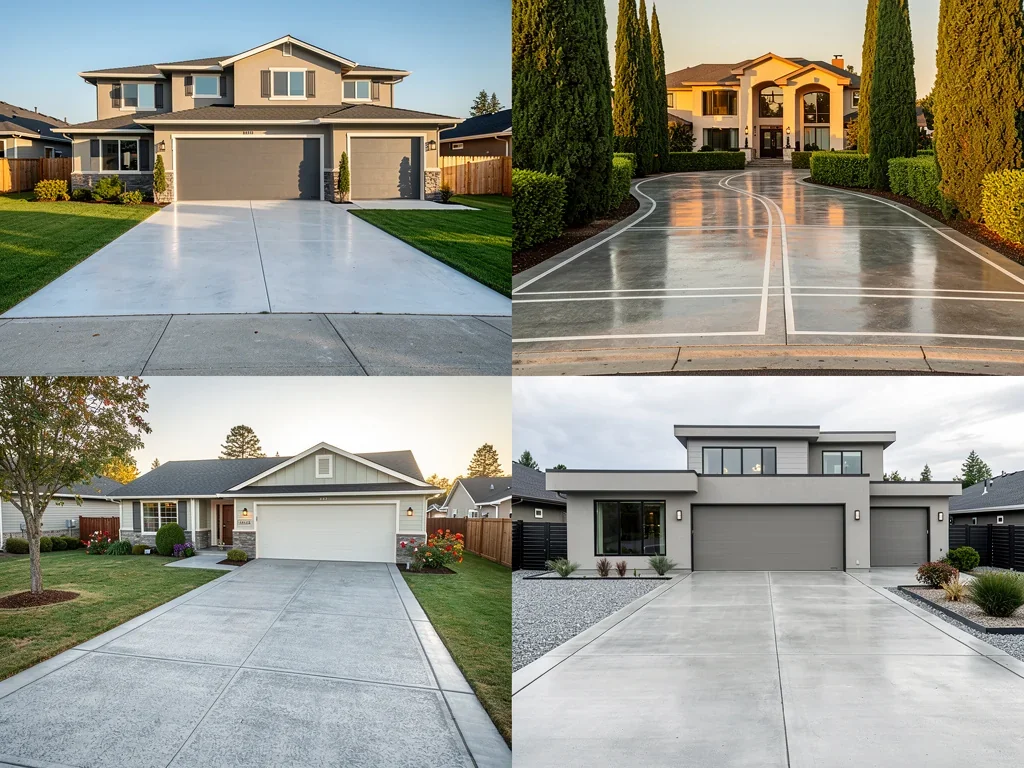
2026 Concrete Driveway Costs at a Glance
Here's what homeowners in Cypress, TX can expect to pay for a new concrete driveway — installed, with proper site prep, reinforcement, and finishing. Prices include demolition and removal of an existing driveway where noted.
| Driveway Type | Per Sq Ft | 600 Sq Ft (2-Car) | 900 Sq Ft (3-Car) |
|---|---|---|---|
| Standard Broom Finish (4") | $8–$12 | $4,800–$7,200 | $7,200–$10,800 |
| Exposed Aggregate | $10–$15 | $6,000–$9,000 | $9,000–$13,500 |
| Stamped Concrete | $12–$18 | $7,200–$10,800 | $10,800–$16,200 |
| Stained & Polished | $10–$14 | $6,000–$8,400 | $9,000–$12,600 |
These ranges reflect Cypress-area pricing as of mid-2026. Demolition and removal of an existing driveway adds $2–$4 per square foot. Extended driveways (100+ feet) often benefit from volume pricing.
Why Cypress Homeowners Are Investing in Concrete Now
Cypress has transformed over the last decade. Master-planned communities like Bridgeland and Towne Lake have brought thousands of new homes — and with them, a wave of homeowners who want to upgrade from builder-grade materials or replace aging asphalt driveways from older subdivisions. At the same time, custom builds on larger lots along Fry Road, Barker Cypress, and Mueschke Road are specifying high-end concrete finishes from the start.
Concrete is the default choice here for good reason. It holds up to the Houston-area climate better than asphalt, which softens under summer heat. It doesn't shift as easily on expansive clay soil when properly installed with a gravel base. And it adds measurable curb appeal — something that matters in competitive neighborhoods where home values are closely watched.
Factor 1: Driveway Size and Layout
The largest cost driver is square footage. A standard two-car driveway (roughly 20' x 30', or 600 square feet) is the baseline for most quotes. But Cypress has a lot of variation:
- Standard subdivision driveway: 400–700 sq ft. Two-car width, 25–40 feet long. Common in Fairfield, Coles Crossing, and Longwood.
- Extended driveway: 800–1,200 sq ft. Common on larger lots where the garage is set back from the street, especially along Mueschke Road and in custom sections of Bridgeland.
- Circular or U-shaped driveway: 1,200–2,000+ sq ft. Popular in the higher-end sections of Towne Lake and custom acreage properties. Significantly higher cost due to curves, additional forming, and wider excavation.
- RV or third-car extension: Adds 200–400 sq ft to one side. We're seeing more of these as homeowners add boats, trailers, or extra vehicles.
Factor 2: Concrete Thickness and PSI
Standard residential driveways use 3,000–4,000 PSI concrete at 4 inches thick. That's sufficient for passenger vehicles and light trucks. But if you park a heavy-duty pickup, boat trailer, or RV, we recommend stepping up to 5 or 6 inches — especially on the expansive clay soil common in Cypress subdivisions.
Going from 4" to 6" adds roughly 30–50% to the material cost for the concrete itself, plus additional labor for forming. It's not a small upgrade, but it's far cheaper than replacing a driveway that's cracked under load after two years.
Our recommendation: 4" at 4,000 PSI for most residential driveways. 5–6" if you regularly park anything heavier than an F-150. Always request wire mesh or rebar reinforcement regardless of thickness — it's a small cost relative to the total project and dramatically reduces cracking.
Factor 3: Site Preparation and Soil Conditions
Cypress sits on the same expansive clay belt as the rest of northwest Harris County. The soil swells when wet and shrinks during drought — exactly the cycle that kills poorly-prepared concrete. Site prep is not a corner to cut.
A proper installation includes:
- Excavation to 8–10 inches below finished grade (6 inches to allow for 4" of gravel base plus 4" of concrete).
- Compacted gravel base — 4 to 6 inches of crushed limestone or road base, compacted in lifts. This is non-negotiable on Cypress clay.
- Grading — the subgrade should slope away from the house at a minimum 1% grade (1/8 inch per foot) to prevent water from pooling against the garage or foundation.
- Vapor barrier if the driveway abuts the house, to prevent moisture wicking into the slab.
If you're replacing an existing driveway, demolition and haul-away typically add $1,200–$2,500 depending on size and access. If the existing base is in good condition, it can sometimes be reused — saving on excavation and gravel costs.
Factor 4: Finish Type and Aesthetics
This is where costs diverge significantly. Your choice of finish affects not just appearance but long-term durability and maintenance.
Standard Broom Finish
The most affordable option. Concrete is poured, floated, and finished with a stiff-bristle broom dragged across the surface to create texture. It provides excellent traction when wet and stays cooler underfoot than darker, smoother finishes. The downside is purely aesthetic — it's functional but plain, and in neighborhoods like Bridgeland where home values are high, some HOAs expect a more finished look.
Cost: $8–$12/sq ft. Best value for long driveways or budget-conscious projects.
Exposed Aggregate
After the concrete is poured and partially set, the top layer of cement paste is washed away to reveal the natural stones underneath — usually pea gravel, river rock, or crushed granite. The result is a textured, slip-resistant surface with visual depth that blends well with native landscaping. Exposed aggregate is becoming the most popular upgrade in Cypress because it handles the heat well, provides great traction, and looks far more custom than a broom finish without the maintenance demands of stamped concrete.
Cost: $10–$15/sq ft. Roughly 25–35% more than broom finish.
Stamped Concrete
Stamped concrete uses textured mats pressed into wet concrete to mimic the look of stone, slate, brick, or tile. Color hardeners and release agents add depth and realism. It's the go-to for homeowners in Towne Lake and higher-end subdivisions who want a luxury look without the price of real stone pavers — which run $20–$35 per square foot installed.
The trade-off: stamped concrete needs to be resealed every 2–3 years, especially in Cypress where UV and rain take a toll. It also runs hotter than lighter finishes. Always request an anti-slip additive in the sealer.
Cost: $12–$18/sq ft. The wide range reflects pattern complexity, coloring, and the number of stamp patterns used.
Stained & Polished Concrete
Acid staining penetrates the concrete chemically rather than sitting on top like paint, creating permanent, variegated color that won't peel. Combined with light polishing or a matte sealant, it produces a smooth, modern look. This finish is gaining traction in contemporary builds around Cypress and is often paired with decorative saw-cut patterns.
Cost: $10–$14/sq ft. Best for modern and contemporary homes.
Factor 5: Reinforcements — Rebar vs. Wire Mesh
Reinforcement is the single best thing you can do to prevent future cracking. Two options:
- Welded wire mesh (WWM): 6" x 6" grid of steel wire placed mid-slab during the pour. Adequate for most residential driveways. Adds roughly $0.50–$0.75 per square foot.
- Rebar grid: #3 or #4 rebar tied in a 12–18 inch grid. Stronger than wire mesh and better for heavy loads or problematic soil. Adds roughly $1.00–$1.50 per square foot. We recommend rebar for driveways on soils with high plasticity index — which describes most of Cypress.
Some contractors skip reinforcement to lower their bid. Don't let them. The $500–$800 you save will cost you thousands when the driveway cracks in year two or three.
Factor 6: Labor and Material Costs in 2026
Concrete pricing in the Houston metro has been relatively stable in 2026 compared to the volatility of 2024–2025. Ready-mix concrete delivered to a Cypress job site runs roughly $145–$175 per cubic yard for a 4,000 PSI mix, depending on distance from the batch plant and any specialty admixtures (accelerators, water reducers, fiber reinforcement).
Labor remains the bigger variable. Demand for concrete work in northwest Harris County is high — driven by new construction in Cypress, Tomball, and Waller — and experienced finishing crews are booked weeks out during peak season (April–October). Expect to pay more for work scheduled on short notice during the summer months.
Cypress-Specific Cost Add-Ons to Budget For
- Driveway approach / apron: The section that connects your driveway to the street. If it crosses a Harris County right-of-way, you may need county approval and inspection. Some subdivisions have specific standards for apron width and thickness. Budget $500–$1,500 extra if the existing apron needs replacement.
- Drainage channels or trench drains: Many Cypress lots slope toward the street, but some custom properties need a trench drain across the driveway entrance to manage stormwater runoff. Adds $800–$2,000 depending on length.
- Expansion joints and control joints: Standard in every driveway but more extensive on larger pours. Not a line-item upcharge — it's built into the square-foot price — but make sure your contractor includes them in the bid. You want control joints every 8–12 feet in both directions.
- HOA architectural review: Many Cypress communities (Bridgeland, Fairfield, Coles Crossing, Longwood, Blackhorse, etc.) require HOA approval before concrete work begins. The application fee is typically $50–$200, and turnaround is 2–4 weeks. A good contractor handles this paperwork, but the timeline is real — don't expect to call Monday and get concrete poured Friday in an HOA community.
Concrete Driveway vs. Asphalt: The Cypress Equation
Some older Cypress neighborhoods still have asphalt driveways, and homeowners occasionally ask whether asphalt is cheaper. Short answer: asphalt runs $4–$7 per square foot installed — roughly half the upfront cost of concrete. But in the Houston-area climate, asphalt has serious downsides:
- Heat softening: Asphalt absorbs and retains heat, reaching surface temperatures of 150°F+ in August. It can soften enough to show tire marks and indentations from jack stands or trailer jacks.
- Shorter lifespan: 15–20 years for asphalt vs. 25–30+ for properly installed concrete. You'll resurface asphalt once or twice in the same period.
- Maintenance: Asphalt needs sealcoating every 2–3 years ($300–$600 per application for a standard driveway) to prevent UV and water damage.
- Resale perception: In Cypress subdivisions where concrete driveways are the norm, an asphalt driveway can hurt curb appeal and resale value.
Over a 25-year period, concrete is typically cheaper in total cost of ownership — even with the higher upfront price.
How to Get an Accurate Quote: 5 Questions to Ask
When you call for estimates (and you should get at least three), ask these questions to make sure you're comparing apples to apples:
- What PSI and thickness are you quoting? If one contractor quotes 3,000 PSI at 4 inches and another quotes 4,000 PSI at 5 inches with rebar, they're not quoting the same driveway.
- Does the price include demolition and haul-away of the existing driveway? If you're replacing, this should be a line item.
- How many inches of compacted base are included? You want at least 4 inches. If the answer is "we pour on grade," find another contractor.
- What reinforcement is included? Wire mesh or rebar — confirm it's in the quote.
- Do you handle HOA submittals and county permits? A contractor who works in Cypress regularly should handle this with no hesitation.
Seasonal Timing: When to Pour in Cypress, TX
Concrete can be poured year-round in the Houston area, but the best windows are October–November and March–May. Temperatures in the 50–80°F range allow concrete to cure at the ideal rate — strong, slow, and without excessive shrinkage cracking.
Summer pours (June–September) are doable but require careful timing. Crews typically pour at first light and use set-retarding admixtures to prevent the concrete from curing too fast in the heat. Winter pours carry minimal risk in Cypress — it rarely drops below freezing long enough to matter — but cold-weather admixtures may be needed December through February.
If you're planning a fall installation, August and early September are the right time to book. Most quality crews are scheduled 3–6 weeks out during peak season.
The Bottom Line
For most Cypress homeowners in 2026, a standard two-car concrete driveway with broom finish, proper base, wire mesh reinforcement, and demolition of the existing driveway will land in the $5,500–$8,000 range. Upgrading to exposed aggregate or stamped will push that to $7,500–$12,000. Extended driveways and three-car configurations scale proportionally.
The most expensive mistake you can make is choosing the lowest bid that skips on base prep or reinforcement. Concrete is a long-term investment. The difference between a $5,000 driveway and a $7,000 driveway is often the difference between one that cracks in three years and one that looks great in twenty.
Get a Free Driveway Estimate in Cypress
We pour driveways in Cypress regularly — from standard replacements in Coles Crossing to custom stamped entries in Bridgeland. We'll walk the site, talk through finish options, handle HOA paperwork, and give you a detailed written quote.
Call (346) 589-8600 or request a free estimate online. Same-week site visits are available, and we'll have your quote to you within 48 hours.
Free Driveway Estimate — Cypress, TX
Get a detailed written quote for your concrete driveway. We handle HOA submittals and county requirements.
Request Free Estimate (346) 589-8600